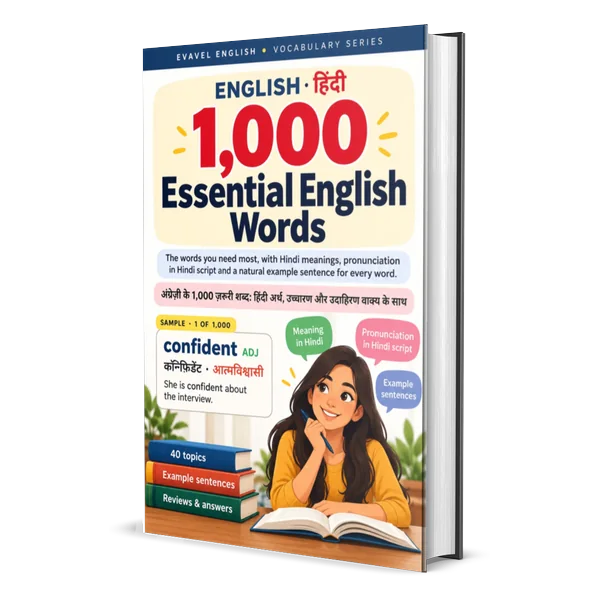
Vocabulary
1,000 Essential English Words
Core words in 40 everyday topics, each with its Hindi meaning, a pronunciation guide and one natural example.
PDF · English + HindiA free, global notebook for English learners
English Notes is a free, growing library of grammar, vocabulary, idioms, writing and exam-prep notes — written in plain language for learners in every country, at every level.
Browse the notebook
Every section is written the same way: plain explanations first, then real examples, then common mistakes — so you always know exactly what to practise next.
Tenses, articles, prepositions, sentence structure and every rule explained with real examples, not just tables.
Word powerEveryday words, academic vocabulary, and word families organised by theme and situation, not random lists.
Natural EnglishThe expressions native speakers actually use — explained with meaning, origin, and example sentences.
SkillsEssays, formal letters, emails, and reports — structures and templates you can adapt for any topic.
SkillsSound patterns, stress, intonation, and confidence-building notes for speaking clearly and naturally.
ExamsFocused notes and strategies for IELTS, TOEFL, PTE, Cambridge and other major English exams.
ProfessionalEmails, meetings, presentations and workplace vocabulary for professional, global communication.
Level: A1–A2The very first steps — alphabet, basic sentences, everyday phrases — explained slowly and simply.
OngoingStudy strategies, common-mistake round-ups, and short reads to keep your English improving every week.
Your learning roadmap
The six CEFR levels are the international standard for describing language ability. Find the stage that sounds like you, then work through the notes linked under it. Not sure? Take the free English level test first.
You can introduce yourself, ask simple questions and understand slow, clear everyday phrases.
Focus: the alphabet and sounds, be and have, present simple, 500 core words.
You can talk about your routine, family and past events, and handle shopping or directions.
Focus: past simple, present continuous, articles, everyday phrases.
You can deal with travel, describe experiences and plans, and give simple reasons for opinions.
Focus: present perfect, conditionals, modal verbs, connected speech.
You can discuss abstract topics, argue a point and write clear, structured essays and emails.
Focus: passive voice, reported speech, essay structure, collocations.
You can express yourself fluently for study and work, and produce well-organised complex texts.
Focus: advanced vocabulary, mixed conditionals, academic and exam writing.
You can understand virtually everything and express fine shades of meaning naturally.
Focus: idioms, phrasal verbs, tone and register for professional English.
Free grammar cheat sheet
The four reference tables learners look up most — on one screen. Each links to a full lesson with examples, common mistakes and practice.
Three times × four aspects. Example verb: work.
| Past | Present | Future | |
|---|---|---|---|
| Simple | worked | work / works | will work |
| Continuous | was working | am/is/are working | will be working |
| Perfect | had worked | have/has worked | will have worked |
| Perf. cont. | had been working | have/has been working | will have been working |
Every English word does one of these jobs in a sentence.
| Part | Job | Examples |
|---|---|---|
| Noun | names a person, place, thing, idea | teacher, Delhi, love |
| Pronoun | replaces a noun | she, it, they |
| Verb | action or state | run, is, think |
| Adjective | describes a noun | big, happy |
| Adverb | describes a verb/adjective | quickly, very |
| Preposition | shows relation (place, time) | in, on, at |
| Conjunction | joins words or clauses | and, but, because |
| Interjection | expresses emotion | wow, oh |
Choose by time and how real the situation is.
| Type | Form | Example |
|---|---|---|
| Zero | if + present, present | If you heat ice, it melts. |
| First | if + present, will | If it rains, I'll stay in. |
| Second | if + past, would | If I were rich, I'd travel. |
| Third | if + had V3, would have V3 | If I'd known, I'd have come. |
Three questions decide almost every case.
| Ask | Then use | Example |
|---|---|---|
| Is it specific / already known? | the | Close the door, please. |
| One, singular, countable, not specific? | a / an | I need a pen. An hour later… |
| Plural or uncountable, in general? | no article | Dogs are loyal. Water is vital. |
A or an? Go by sound, not spelling: an hour, an MBA, a university, a one-way ticket.
All article rules →Study offline
Every note on this site stays free. If you would rather work through one complete book — on your phone, on a train, or printed and marked up with a pen — these PDF guides put a whole topic in one place, with Hindi meanings and pronunciation where it helps.
Core words in 40 everyday topics, each with its Hindi meaning, a pronunciation guide and one natural example.
PDF · English + Hindi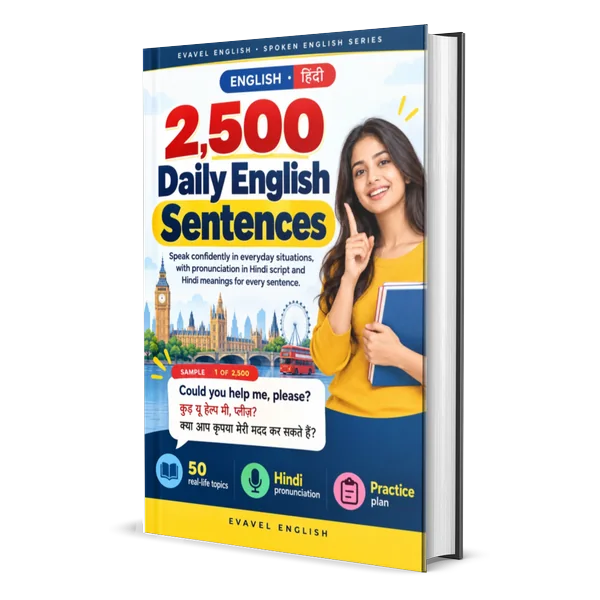
Ready-to-say sentences for 50 real situations, from greetings to the doctor’s office, with Hindi pronunciation.
PDF · 177 pages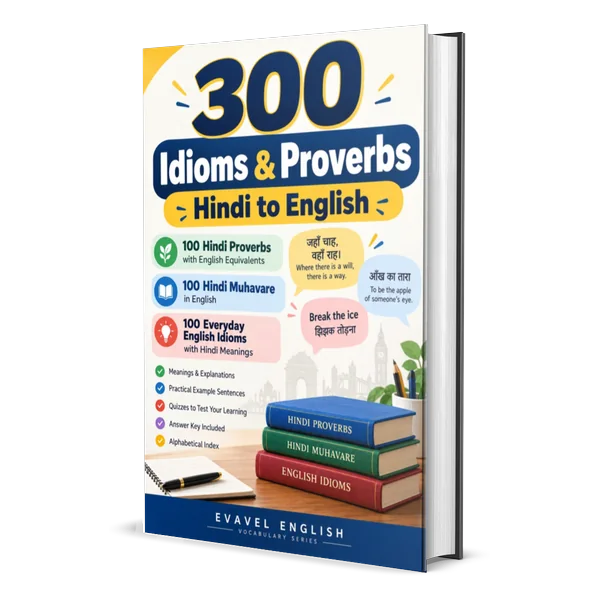
Find the English match for the muhavare and kahavat you already know — plus everyday English idioms explained in Hindi.
PDF · 57 pages
Forty questions you are likely to face, sample answers you can adapt, and a seven-day plan to prepare.
PDF · 72 pages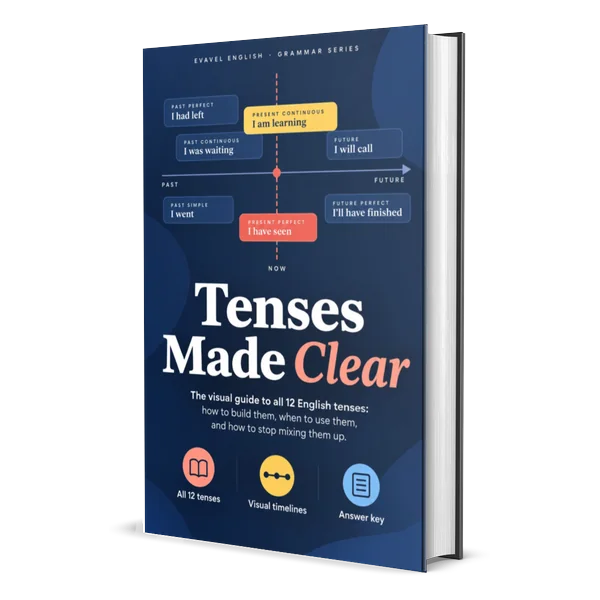
Timelines, side-by-side comparisons and exercises that make the twelve tenses finally click.
PDF · 97 pagesIndia: pay in rupees with UPI or an Indian card. Outside India: use the international button to pay in US dollars. Each ebook is a PDF you download straight after paying.
Compare all five ebooksNow expanded
We've grown beyond the original nine subjects — pronunciation, phrasal verbs, reading, listening, and hands-on practice tools are all part of the notebook now.
Vowels, consonants, word stress, and rhythm — the full sound system, explained clearly.
Natural English100+ everyday phrasal verbs organised by work, travel, and daily life.
ComprehensionSkimming, scanning, and context clues for faster, more accurate comprehension.
ComprehensionHow to follow natural-speed speech, connected sounds, and different accents.
CEFR frameworkWhat A1 through C2 actually mean, and where to focus at each stage.
Test yourselfInteractive quizzes with instant scoring and clear explanations.
UtilitiesA live word and character counter, with more tools on the way.
For educatorsLesson-planning guidance and a reusable lesson plan template.
Study materialHow to turn any note on the site into focused practice material.
Our mission
Millions of people want to learn English — for a better job, to study abroad, to talk with family across borders, or simply to feel confident in a global conversation. Too often, that education sits behind a paywall, a subscription, or an app that nags you to upgrade halfway through a lesson.
Every note on this site is written in plain, simple language on purpose. Learning a new language is hard enough without also decoding academic jargon written for native speakers. Whether you're a student in a small town, a professional preparing for an international interview, or someone teaching yourself from a phone with limited data — this notebook is built for you.
English Notes by the numbers
Fresh every day
A small, rotating pick from the notebook — grammar, vocabulary, idioms, and pronunciation, one bite-sized note at a time.
Red-pen corrections
These errors appear again and again in learners' speaking and writing, whatever their first language. Tap any card for the full rule.
Thinking in Hindi, speaking in English
When we translate word-for-word from Hindi, the grammar is often fine but the English sounds unusual to listeners from other countries. These are the phrases that most often give it away.
Indian English is a real, respected variety of English, and these forms are perfectly understood at home. Switch to the second version when you are writing to, interviewing with, or presenting to people from other countries. For hundreds more everyday words with Hindi meanings, see the daily-use English words list or the 1,000-word ebook.
Not sure where to start?
Same notebook, four common starting points — choose the one closest to your goal right now.
IELTS, TOEFL, and PTE strategy notes, structured around what examiners actually score.
GoalEmails, meetings, and professional phrases for clear, confident workplace communication.
GoalPronunciation, natural rhythm, and the idioms that make conversation sound fluent.
GoalSlow, clear first steps — basic sentences, everyday phrases, and core grammar.
Why learners use this notebook
Examples use international contexts and neutral, standard English — not slang or references tied to one country — because English is learned everywhere, for different reasons.
Instead of bare rule tables, every note explains why a rule works, with a "common mistake" callout so you can check your own writing against it.
Each subject moves from foundations to advanced use, so you can follow one topic start to finish or jump straight to what you need.
No paywalls, no mandatory sign-up. Notes are supported by light, unobtrusive advertising outside the lesson content — never inside it.
Know the language
A few facts that explain why English works the way it does — and why some parts feel harder than others.
Most-read notes
The guides learners open most — each one ends with practice questions and answers.
Positive, negative and question formulas for every tense, signal words and a Hindi tense-identification guide.
GrammarZero, first, second, third and mixed conditionals — with unless, in case and a practice exercise.
Pronunciation5 vowel letters, 20 vowel sounds, an IPA chart, diphthongs and the schwa.
GrammarConvert any sentence in 4 steps, with the passive form of every tense and modal.
GrammarThe full system, including a/an exceptions like an hour, a university and an MBA.
WritingA reusable template, the PEEL paragraph formula and a full annotated example essay.
Exam PrepCharts, processes, maps and the GT letter — structure, vocabulary and a sample answer.
VocabularyCore vocabulary grouped by real situations — home, travel, work and shopping.
Learn by doing
Seven free, interactive quizzes and tools to check what you've actually learned — instant feedback, no sign-up, no cost.
10 questions on tenses, articles, prepositions, and agreement.
Take the quiz →Test your word power with synonyms and word choice.
Take the quiz →12 questions to estimate your CEFR level, A1 to C2.
Find your level →Live word and character count for essays and exam answers.
Open the tool →A longer test across tenses, articles, modals and more.
Start the test →Meanings, synonyms and word choice in context.
Start the test →Trivia about English itself — words, history and spelling.
Take the quiz →Study routine
Short, daily practice beats long, occasional sessions. This routine covers all four skills — reading, listening, speaking and writing — in half an hour.
Repeat it five days a week and you will cover roughly two hours of grammar and two hours of real input every week. Adjust the topics to your level using the roadmap above.
See the full weekly plan| Time | What to do |
|---|---|
| 5 min | Review vocabulary. Revise yesterday's words, then add 5 new ones with an example sentence each. Try daily-use words. |
| 10 min | One grammar note. Read a single lesson and do its practice exercise — e.g. present perfect. |
| 10 min | Real input. Read a short article or listen to a podcast clip. Note 2–3 useful phrases. See reading and listening. |
| 5 min | Produce. Say a 1-minute summary aloud, or write 3–4 sentences using today's grammar and words. |
How English Notes works
Browse by subject — Grammar, Vocabulary, Idioms — or jump straight to a goal, like exam prep or beginner basics.
A plain-language explanation, real example sentences, and a "common mistake" callout so you can self-check.
Use the quick exercises where included, then follow the links to the next related note to keep building.
For exam takers
A quick look at how the three major English exams compare. Formats and timings change, so always confirm on the official exam website before booking.
Read the Full Comparison| Exam | Scoring | Results in |
|---|---|---|
| IELTS | Band 0–9 | 1–2 days (computer) |
| TOEFL iBT | 1–6 bands (since Jan 2026) | Within days |
| PTE Academic | 10–90 points | ~2 business days |
English for job interviews
Interviewers rarely reject good candidates for small grammar slips. They reject answers that are vague. Here is what the difference looks like for four questions you will almost certainly be asked.
| Question | Weak answer | Stronger answer | Why it works |
|---|---|---|---|
| Tell me about yourself. | “I am a hardworking and honest person.” | “I’m a commerce graduate. For the last year I’ve handled invoices for a logistics firm, and I cut our monthly backlog roughly in half.” | Facts and a result prove the qualities you only claimed. |
| Why do you want this job? | “Because I need a good salary and growth.” | “Your team builds software for small shops, and those are exactly the customers I supported in my last role.” | It connects your experience to their work. |
| What is your biggest weakness? | “I am a perfectionist.” | “I used to stay quiet in meetings. Now I note down two points beforehand and make sure I share at least one.” | A real weakness plus a fix shows self-awareness. |
| Any questions for us? | “No, everything is clear.” | “What would a successful first three months look like in this role?” | A thoughtful question signals genuine interest. |
Want the full set? Interview Ready covers 40 common questions with model answers, the STAR method, video-interview checklists and follow-up emails. For workplace phrases, start with meeting English.
See Interview ReadyBuild your vocabulary
Useful B2–C1 words that make speaking and writing sound more precise — each with its meaning and a natural example sentence.
Short and clear, using no unnecessary words.
"Keep your answer concise — examiners reward clarity."
Showing great attention to detail.
"She is meticulous about checking her essays for errors."
Able to recover quickly from difficulties.
"Resilient learners treat mistakes as practice."
To delay doing something you should do.
"I procrastinated all week and studied the night before."
Having more than one possible meaning.
"The question was ambiguous, so I asked the teacher."
Dealing with things in a practical, realistic way.
"A pragmatic study plan fits into your real schedule."
Speak in chunks, not single words
Fluent speakers don’t build every sentence from zero — they reuse ready-made openings. Learn the highlighted part as one unit, then finish it with your own idea.
I was wondering if you could look over my essay.
Would you mind closing the window?
It depends on the traffic, but usually forty minutes.
I’m thinking of joining an evening course.
The thing is, I’ve never driven in heavy rain.
Do you happen to know where platform four is?
I’d rather walk than wait twenty minutes for a bus.
It’s worth booking your tickets early in December.
Practise them aloud for a week and they start to come out on their own. For situation-by-situation practice, read daily-use English sentences and polite English phrases, or work through all 2,500 sentences in the ebook.
See 2,500 Daily SentencesJump straight to a topic
From the blog
Study tips and practical guides from the English Notes blog.
An hour-based timeline for moving through each CEFR level, from complete beginner to advanced fluency.
Study TipsA practical framework for a sustainable daily routine, plus a full sample weekly plan you can adapt.
GrammarA category-by-category guide to the mistakes learners make most, with correction strategies for each.
Frequently asked
Begin with the alphabet and English sounds, the verbs be and have, the present simple and about 500 everyday words. Our English for Beginners section and the A1 guide set out exactly what to learn first.
It depends on your starting point and how much you practise. As a rough guide, each CEFR level takes a few hundred hours of guided study. See how long it takes to learn English for a level-by-level timeline.
Speak a little every day, even alone: summarise what you read aloud, record yourself, and learn whole phrases instead of single words. Our guide to improving English speaking skills lists nine practical habits.
Start with parts of speech, the present simple and continuous, the past simple, articles and subject-verb agreement. These cover most everyday mistakes. The Grammar section is organised in this order.
Yes. Every note is free to read, with no account or sign-up required. We may show light, clearly-labelled advertising outside of lesson content to help cover hosting and writing costs, but the notes themselves are never behind a paywall.
Beginner through advanced — roughly CEFR A1 to C2 — organised by subject rather than strict level, so you can follow one topic from start to finish or jump straight to what you need. The roadmap above shows a starting point for each level.
Yes — our Exam Prep section includes structure and vocabulary guides for IELTS Writing Task 1 and Task 2, and a comparison of IELTS, TOEFL iBT and PTE Academic to help you choose the right exam.
No — the ebooks are optional paid PDFs for learners who want a complete topic in one file for offline study. Every lesson, quiz and tool on this website stays free. See the shop for what each ebook covers.
No. We're an independent educational resource and are not affiliated with IELTS, TOEFL, PTE, or any specific exam board, university, or institution, unless a page explicitly states otherwise.
No account, no cost, no clutter — just clear English notes, organised the way a good teacher would explain them.
Disclaimer: English Notes provides free educational content for general English-learning purposes. We are not affiliated with IELTS, TOEFL, PTE, or any exam board or institution, and content should not be treated as official exam or immigration guidance — always verify current requirements with the relevant official source. See our full Disclaimer for details.